Many Firsts on a Nightmare
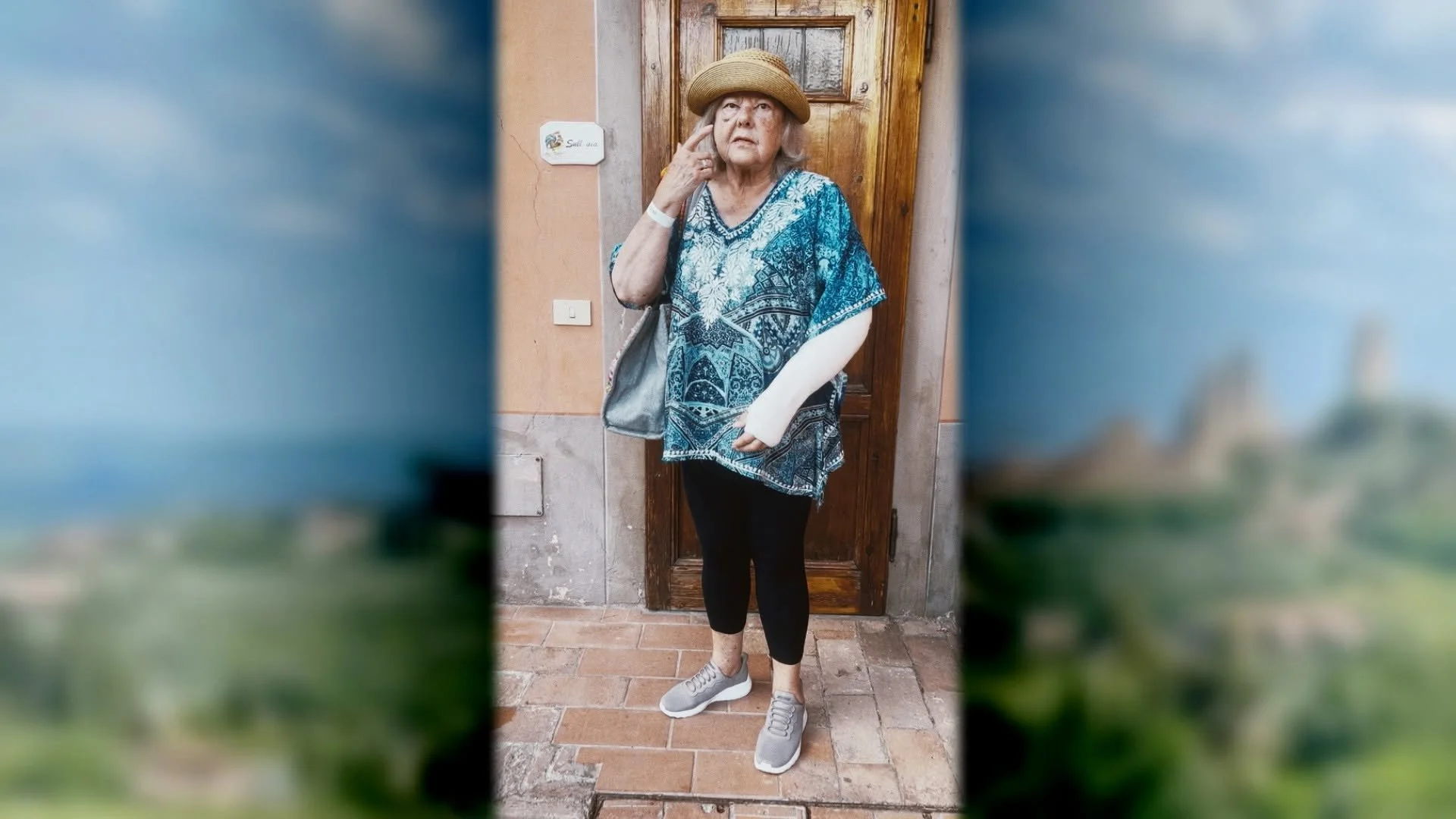
With “A Nightmare in Tuscany,” I feel like I’ve come full circle and married my early love of experimental filmmaking with storytelling that is accessible to doc lovers with a variety of tastes. My primary target audience is seniors and people with senior parents. That said, if we're lucky, we will all find ourselves in one if not both of those positions eventually. This film marks a few firsts for me. It’s the first time I’ve shot the majority of a film on a cell phone because in the midst of this emergency, that’s all I had with me. I shot vertically in Tuscany because that’s the way I was seeing reality. I was so afraid that Mom was going to have a stroke or fall that my gaze was almost always focused on her despite our beautiful surroundings. I was also sending most of those videos back to family and friends' cell phones so they could follow Mom's progress. This is also the first time I’ve narrated my story, turned the camera on myself, and punctuated funny moments with unexpected imagery for comic relief. I'm excited to see audiences respond to this film and for the discussions we will have around senior health care and travel as well as acquired disabilities and adult caretaking. But above and beyond any of that, I relish the fact that long after my mom and I are both gone, our descendants in some unknown future time will have a window into our relationship, the time we lived in and how humor helped us survive.

Two summers ago, my mom had a near-fatal accident in Florence, Italy. 48 hours after a harrowing phone call from the hospital, I whisked her away to an olive farm in Tuscany (an agriturismo) to recover. Due to a brain bleed and a fractured occipital bone (the bone beneath the eye socket), she was not allowed to leave the country for two weeks, and even then she had to get permission from the doctors who had treated her at two different hospitals.
On the plane to Italy, it dawned on me that I should film our time there in case we needed evidence for the travel insurance company. The only tool I had was my cell phone, so that’s what I used. I spent most of my time shopping for groceries, cooking, cleaning, and taking Mom to hospital visits. How strange to be in one of the most beautiful places in the world and barely see the outside of our little apartment! After a few days of documenting our stay I realized that I was making the most personal documentary I have created to date, and that despite the serious content, it included a lot of funny moments. I cannot stress enough how essential humor is in healing. I’m so excited to share our story with you and hope that the obstacles we overcame with the health care systems in Italy and the U.S. as well as the shady travel insurance company, will spare other seniors from experiencing the hardships that we faced.
At 40 minutes, A Nightmare in Tuscany is my first “long, short,” and my third documentary film. I plan to self-distribute it via community-based screenings, film festivals, and online events. I will also pursue a virtual university tour and speaking/screening gigs at senior-focused conferences.
Reflections on My First Feature…
It all begins with an idea.

Sumaiyya and Dave at The Hollywood Theater in Portland, Oregon
- Photo by Laurel Degutis
Back in 2013, I shot Live Out Loud, the story of three people experiencing homelessness in Portland who begin to heal from childhood trauma by learning to make films. This documentary would not have been possible without the honesty, trust, and cooperation of Sumaiyya, David, and John, whom I had the honor to follow over a year while they created group projects and their first films with BCCTV, a class funded by a Regional Arts & Culture Council grant. Most people who’ve experienced homelessness have had their self-esteem trampled on again, and again, and again. Recovery from life on the streets requires food and shelter, yes, but it also requires self-worth and belief in the possibility of a better future. I am working hard to make sure this film educates our leaders and policy makers about the root causes of homelessness and inspires them as well as arts organizations to partner with non-profit groups to create similar programs.
When I finished filming Live Out Loud, I never imagined that it would be eight years before it was ready to release. But life is unpredictable. Mine has been full of twists and turns from battling a mystery disease for over a decade to losing three of my closest family members, including my father and both of my feline babies who were with me for almost 20 years. In between, I somehow made a short drama called “Esperanza’s Turn” that’s had an exciting festival run and been picked up for distribution by Global Films Online, the first streaming platform to focus solely on nonviolent films.
I also took time to co-produce a series called Connectivity Project with my friend Rose Madrone (director) because I felt her project’s mission to educate people about the ripple effects of our actions in an interconnected world is absolutely vital right now. I’m delighted to share that Connectivity Project was picked up for distribution by Bullfrog Films, one of the oldest educational video distribution companies in the U.S. Please tell all of your educator friends about it.
Although it was shot years ago, Live Out Loud is more relevant than ever today as the housing crisis continues to spiral out of control in our country. I don’t need to tell any of you living in Portland, Oregon how dire the situation has become. As more and more people without a home have gravitated to the social services and temperate climate that Portland provides, the more burdened the system has become. Without adequate resources, social problems at the encampments that fill nearly every corner of the city have escalated.
We will never solve the homeless crisis in the U.S. if we do not fund and create programs that address the key underlying causes—trauma, neglect, abuse, addiction, lack of mental health care, lack of access to health care, poor nutrition, systemic racism, educational inequity, overburdened public school systems, and the list goes on. Our streets and prisons are full of people with mental illnesses and addiction issues who were never adequately treated because our society refuses to see those problems as diseases rather than character flaws that should be punished. Some day, people will be horrified by our ignorance. We have to change our way of thinking. We have to become more compassionate and take action if we want to live in a more connected, peaceful society.